
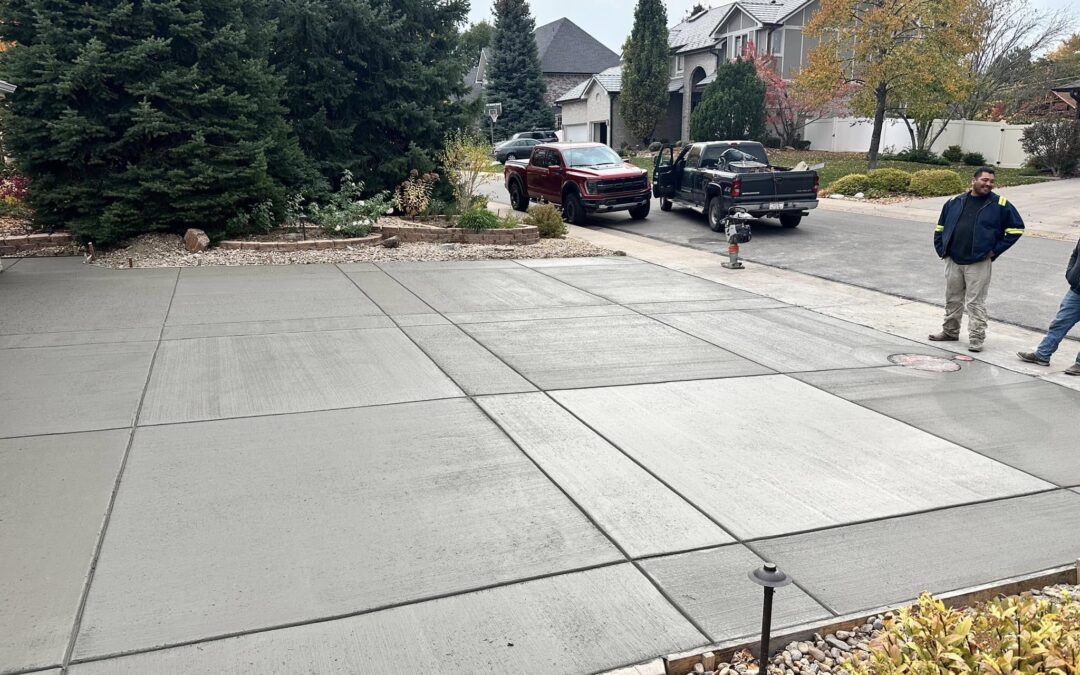
Concrete vs. Gravel Driveway: Which Is Right for Your Colorado Home?
Gravel driveways are common across Colorado — particularly in rural areas, on longer rural driveways, and in newer developments where concrete hasn’t been put in yet. But when it’s time to make a decision, the concrete vs. gravel question deserves a real look. Here’s how they actually compare for Colorado homeowners.
Upfront Cost
Gravel wins this one, clearly. A gravel driveway typically runs $1–$3 per square foot installed — roughly 3–5x cheaper than concrete upfront. For a long rural driveway (1,000+ sq ft), the cost difference can be substantial: a $1,500 gravel driveway vs. an $8,000–$12,000 concrete one.
Concrete’s upfront cost reflects the materials, labor, and time required to do it right — proper subgrade prep, forming, reinforcement, pour, and finishing.
Long-Term Cost and Maintenance
Concrete wins long-term, usually by a wide margin.
Gravel requires ongoing maintenance: regrading every 1–2 years, replenishing material as it migrates, dealing with ruts and potholes, and controlling weed growth. Over 20 years, a gravel driveway’s total cost often approaches or exceeds that of concrete — without ever matching the performance or appearance.
Concrete, properly installed and sealed, can last 30–40 years with minimal maintenance. Sealing every 3–5 years helps protect the surface. Occasional crack repairs may be needed, but well-installed concrete driveways are largely set-it-and-forget-it.
Performance in Colorado Conditions
Both materials face Colorado’s freeze-thaw cycles, but they respond differently:
- Concrete: Vulnerable to surface scaling from de-icing salt, but air-entrained mixes and proper sealing handle freeze-thaw well. Does not rut, wash out, or displace like gravel.
- Gravel: Freeze-thaw doesn’t damage the material itself, but frost heave can create significant surface irregularities. Spring thaw turns gravel driveways soft and rutted. Gravel also migrates onto lawns and into the street.
In suburban areas like Castle Rock and Parker, HOA rules often prohibit gravel driveways anyway — and even where they don’t, neighboring properties tend to push toward hard surfaces.
Appearance and Curb Appeal
Concrete driveways — especially when paired with decorative finishes, borders, or stamped patterns — dramatically improve curb appeal and home value. Gravel driveways are functional but utilitarian.
If you’re in a neighborhood in Brighton or Broomfield where neighbors have concrete driveways, a gravel driveway stands out — not in a good way.
When Gravel Makes Sense
Gravel is still the right call in some situations:
- Long rural driveways where concrete is cost-prohibitive
- Temporary access roads or construction driveways
- Properties where zoning, drainage, or permeable surface requirements favor it
- Budget-constrained situations where “good enough now” is acceptable
The Verdict
For most Colorado suburban homeowners, concrete is the better long-term investment. It looks better, performs better, lasts longer, and adds more value to the home. Gravel is cheaper upfront but rarely wins over a 10+ year horizon.
If you’re on the fence, get a concrete quote. The difference may be less than you expect — especially for shorter driveways.
Ready for a free quote? Contact JXB Concrete — serving Castle Rock, Parker, Brighton, Broomfield, and communities across the Denver metro.